Fracture-Based Continuum Modeling (FBCM) describes a technology for modeling fractures explicitly in continuum analysis.
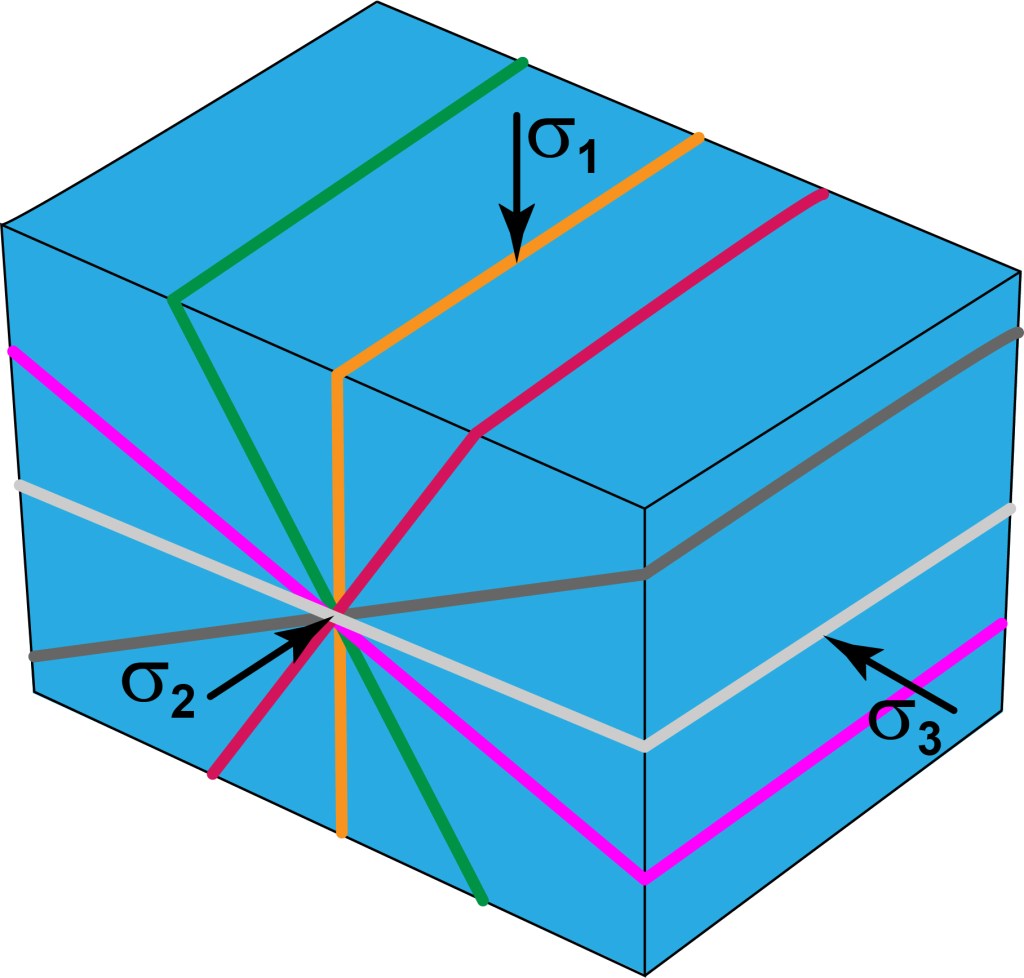
- The model domain is discretized into continuum elements (sub-volumes of the domain), referred to as domain elements.
- Preexisting fractures are discretized into planar segments based on intersections with the domain elements.
- New fractures are generated in planar segments based on mechanical conditions in the domain elements.
- Each domain element can host up to six fracture segments
- Four pre-existing fractures
- Two new fractures
- Each fracture segment intersects the element centroid;
- Terminates on four element faces;
- Has constant dip, dip direction, and aperture;
- and the aperture may vary with time through an analysis.
- The fracture dip, dip direction, and aperture may vary among domain elements, i.e., among fracture segments.
- Each fracture segment is represented mathematically as a local transformation matrix that conveys the fracture behavior to the host element.
- The host element, in turn, conveys the fracture behavior to neighboring elements through hydro-mechanical interactions.
- In hydrologic analysis, the fracture transformation matrix is used to calculate fracture-to-element-face connection matrices to define hydrological interactions.
- In mechanical analysis, the element mechanical conditions determine fracture initiation and deformation;
- A new fracture initiates as shear or tensile;
- Every fracture may deform in slip mode or opening mode.
- Fracture aperture is initiated with the fracture and updated incrementally thereafter.
- There is no model prescription for fracture tip phenomena, propagation, or coalescence.
- Hydro-mechanical interactions among elements control fracture propagation and coalescence.
- The hydro-mechanical relationships are enforced through piecewise tensorial aggregation over fractures and unfractured matter.
- FBCM provides several business advantages because of features that can be summarized as follows.
- FBCM models fracture initiation and propagation without re-meshing.
- FBCM stores fracture geometry and aperture as continuum properties and uses the information internally to calculate parameters needed to model individual fractures explicitly.
- Each FBCM model can incorporate large populations of preexisting fractures.
- Incorporates three-dimensional fracture distributions seamlessly by using a continuum framework to store fracture geometry and aperture.
- Calculates the location, dip, and dip direction of new (induced) fractures.
- Calculates fracture aperture for new and preexisting fractures.
- Models several realizations of the preexisting fracture distribution using the same domain grid, to support probabilistic analysis.
- Models at real scale such that simulation results can be used directly in the target application.
- The computer code CanFrac implements FBCM for mechanical analysis.
- Computer code CanFracEnv implements FBCM for hydrological analysis.
 Geological processes modeling (GPM) research Institute